
Attorney v Machine
Industry Breakdown: Legal AI

Welcome to Autopilot's Industry Breakdown Series. Here, we explore and analyze how AI is reshaping different sectors of our economy. If you’re passionate about understanding the forces driving the future, you’re in the right place. In this review, we dive into the legal industry and the latest innovation in the legal tech space.
I. Background
For centuries, the legal profession has upheld justice, maintained order, and safeguarded rights - essential pillars of society. From the earliest known laws inscribed in the Code of Hammurabi around 1750 BC, where King Hammurabi of Babylon established rules to govern his people, to the legal doctrines of Roman Law that emerged over a millennium later and laid the foundation for modern jurisprudence, the law has continuously evolved to meet the complexities of human civilization. For centuries, legal systems were intertwined with the religious and moral codes of their respective cultures, shaping the way laws were crafted and enforced.
In modern day America, the legal industry is vast, with over 1.3 million professionals actively engaged in creating, interpreting, and enforcing laws; navigating a complex framework of federal, state, and municipal laws. Yet inefficiencies remain entrenched, from labor-intensive workflows to costly, manual processes.
Enter artificial intelligence. Legal AI is poised to redefine how law firms and in-house teams operate, offering tools to streamline research, automate repetitive tasks, and improve decision-making.
This report examines the pioneers of Legal AI, the inefficiencies they aim to solve, and the transformative potential for the industry. Whether you're a lawyer curious about the future, an entrepreneur eyeing legal tech opportunities, or simply intrigued by AI's applications in law, this exploration offers a front-row seat to the dawn of a new era - one where technology enhances justice, transparency, and access to legal expertise.

The leading rule for the lawyer, as for the man of every other calling, is diligence. Leave nothing for tomorrow which can be done today. Never let your correspondence fall behind. Whatever piece of business you have in hand, before stopping, do all the labor pertaining to it which can then be done.— Abraham Lincoln, Collected Works Volume II, Sep. 1848 - Aug. 1858
The US Legal System
Today, global legal frameworks are primarily divided among common law, civil law, and, in some regions, customary traditions. Each system reflects a society’s history, values, and governance structures. The US uses a common law system, inherited from the British Commonwealth.

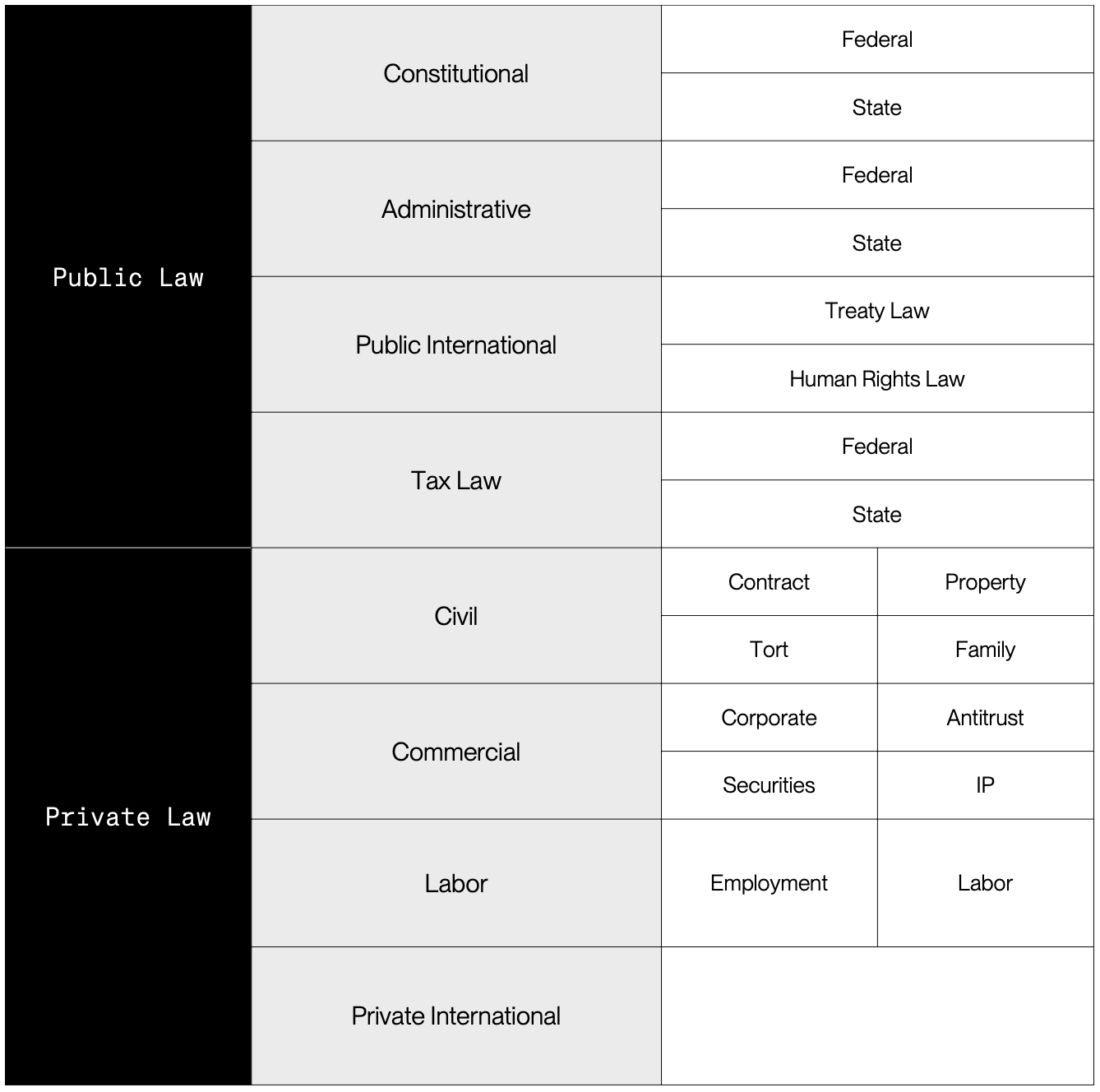
In the US, there are three main levels of law - the federal, the state and the municipal. Within each of these levels, there is a distinction between public and private legislature, with the former governing relationships with individuals and the state, and the latter between individuals and private entities. Even though there is a distinction, naturally these laws are intertwined.
I. Federal Law: At the national level, federal laws govern matters that affect the country as a whole. These laws are derived from the U.S. Constitution, federal statutes, treaties, regulations, and federal case law. Federal courts have jurisdiction over cases involving federal laws, constitutional issues, and disputes between states or international parties.
II. State Law: Each of the 50 states has its own constitution and legal system. State laws address issues not specifically reserved to the federal government by the Constitution. They govern areas such as property, contracts, family matters, and criminal offenses under state statutes. State courts handle the majority of legal disputes in the country.
III. Municipal Law: Municipalities, including cities, towns, and counties, enact ordinances and regulations to address local concerns such as zoning, local safety codes, and municipal services. Municipal courts handle violations of local ordinances and minor civil disputes.
Within each level, there’s a distinction between public law and private law, though they often overlap. Public law governs the relationship between individuals and the government. It includes constitutional law, administrative law, and criminal law. Private law governs the relationships between private individuals and entities. It encompasses areas like contract law, tort law, property law, and family law. Despite the distinctions, public and private laws are intertwined. For instance, a private business contract (private law) must comply with regulations established by government agencies (public law).
The Legal Profession
Lawyers perform a wide range of tasks to represent and advise their clients in legal matters. Within private law, which governs relationships between individuals and private entities, certain practice areas are particularly prominent due to their high demand and volume.
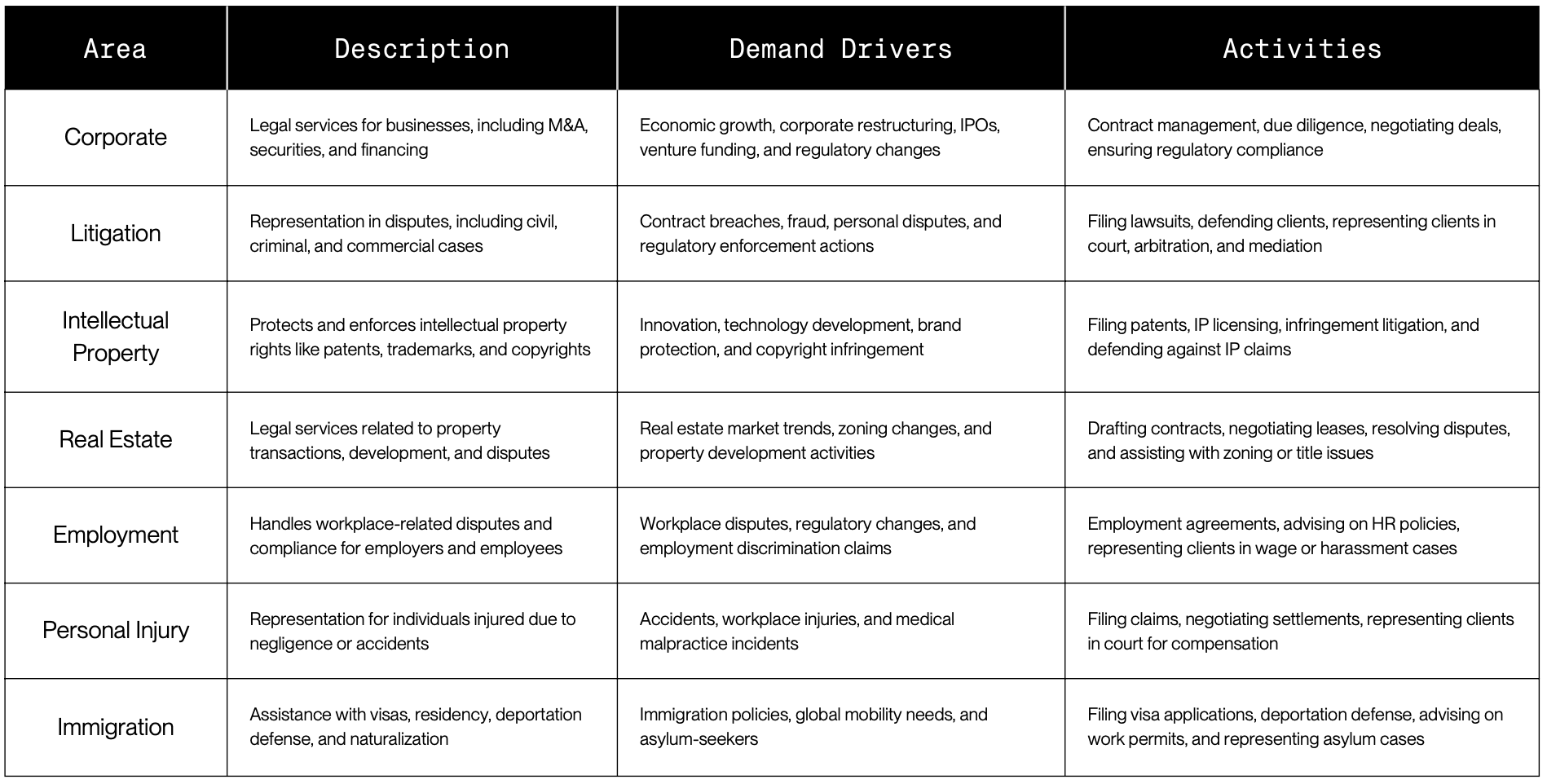
The work of support staff like paralegals, legal assistants, and legal secretaries are normally overseen by lawyers. Within the business world, legal services are provided by two types of lawyers - the outside counsel (law firms), and the in-house counsel. Law firms provide specialized legal services to multiple external clients, focusing on advocacy, litigation, and risk management across various practice areas, often generating revenue through billable hours. In contrast, in-house counsel act as legal generalists within a single organization, addressing internal legal matters such as regulatory compliance, contract negotiation, and policy development, while aiming to reduce external legal costs.

The demand for legal services is intrinsically tied to economic growth, with regulations becoming increasingly complex year after year. Advancements in technology are opening new avenues for legal tech startups and established players to optimize workflows for law firms, while also empowering companies to manage more of their legal needs in-house. In the next sections, we will explore the innovators at the forefront of this transformation, analyze the financial trends shaping the industry, and consider how law firms and in-house teams are likely to evolve in the years ahead.
It depends— Famous legal quote
Introduction to the Innovators
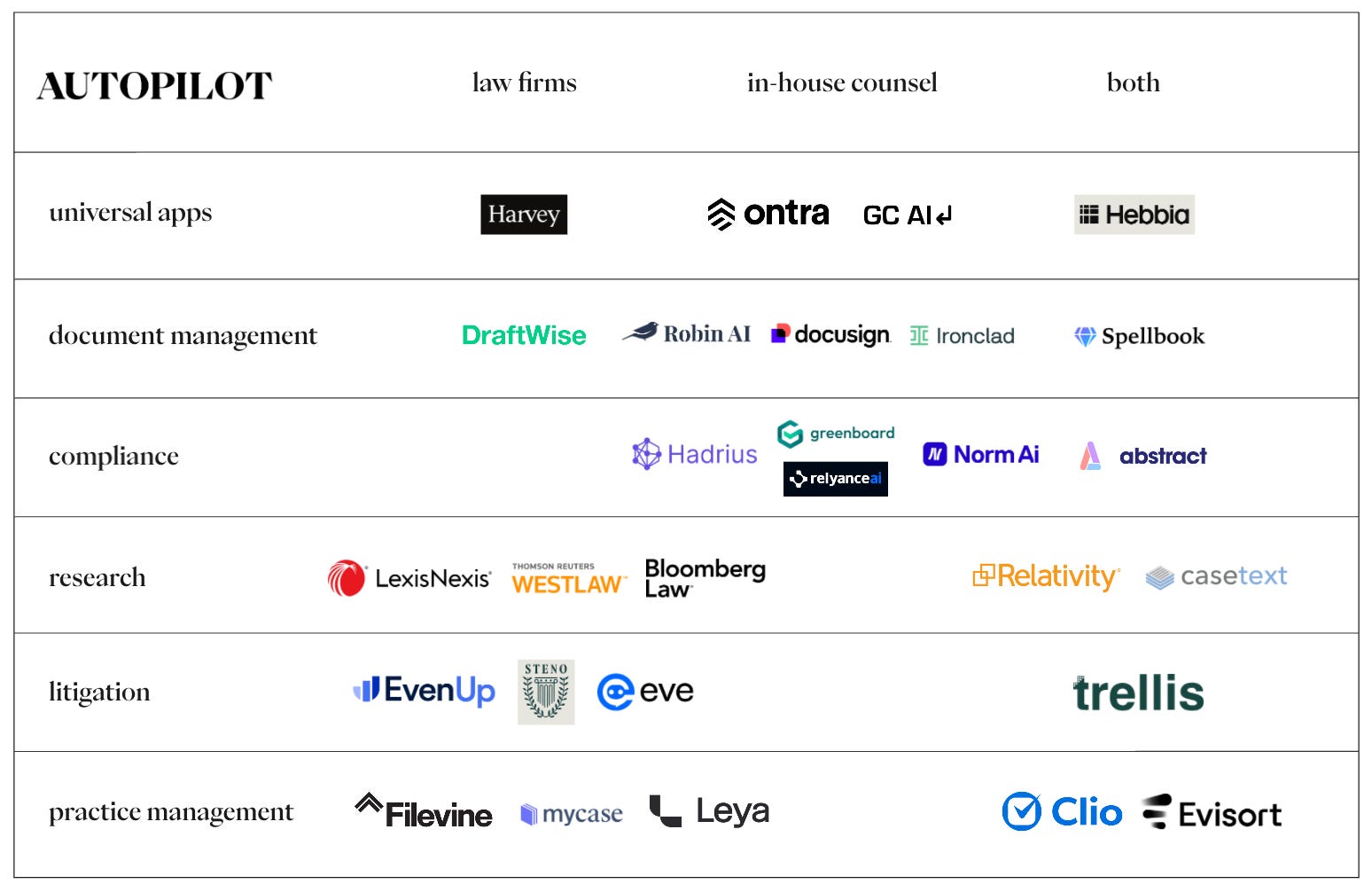
In our research, we closely reviewed over 100 companies, including emerging startups and incumbents like Bloomberg Law and Thomson Reuters, who have ramped up acquisitions in recent years to strengthen their AI capabilities. From cutting-edge copilots for lawyers to agentic tools streamlining compliance and automating due diligence, these companies are pushing the boundaries of what’s possible in legal tech. The most immediate impact is being seen in tasks like contract review, legal research, and compliance management.
To access the full company database, visit the Airtable link below →
Investment Landscape
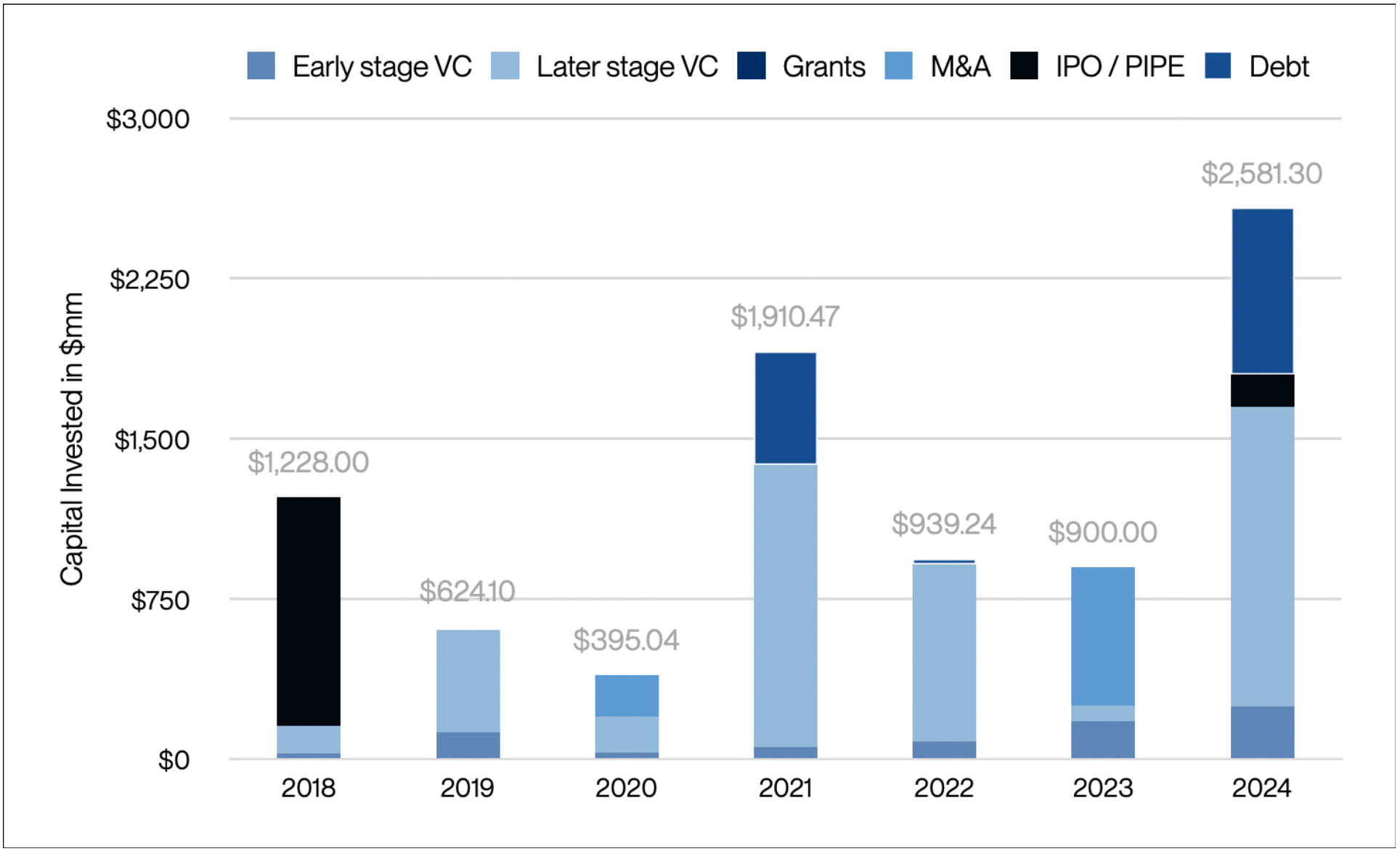
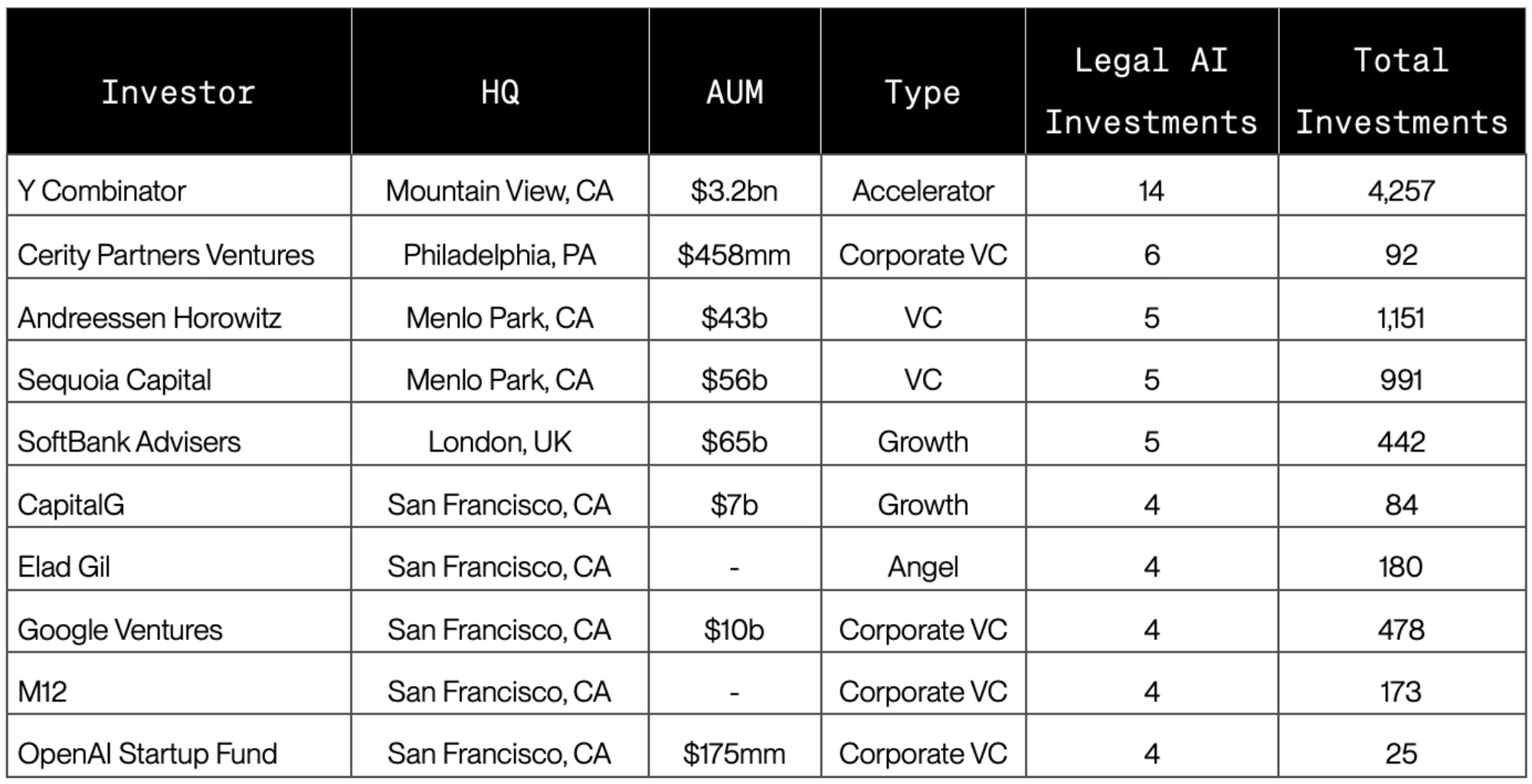
The legal AI sector has attracted billions of dollars in investment from venture funds, corporate VCs, and angel investors, all eager to capitalize on the transformative potential of AI in reshaping legal workflows and services.
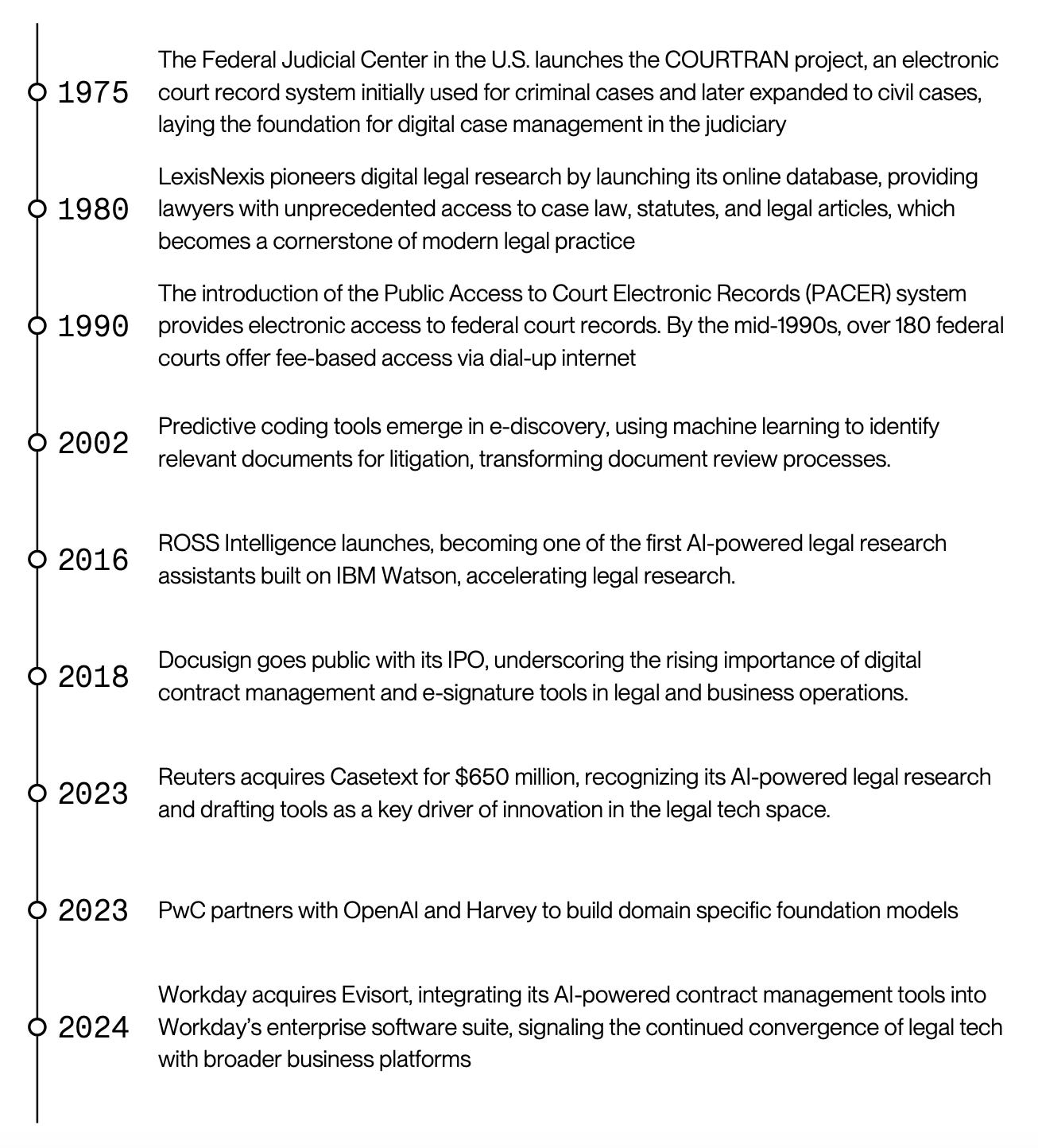
A Short History of Legal Tech
II. The Need
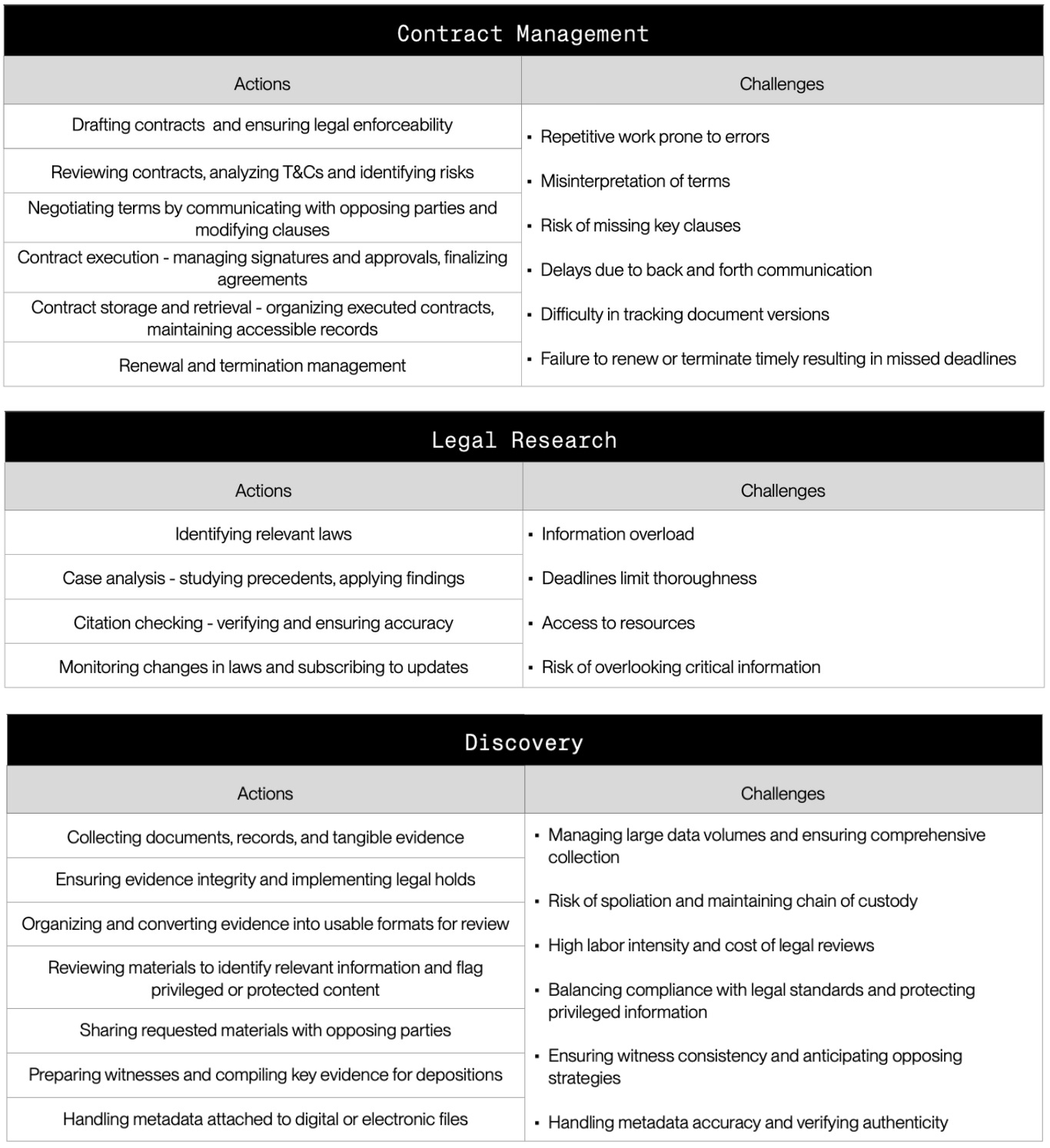
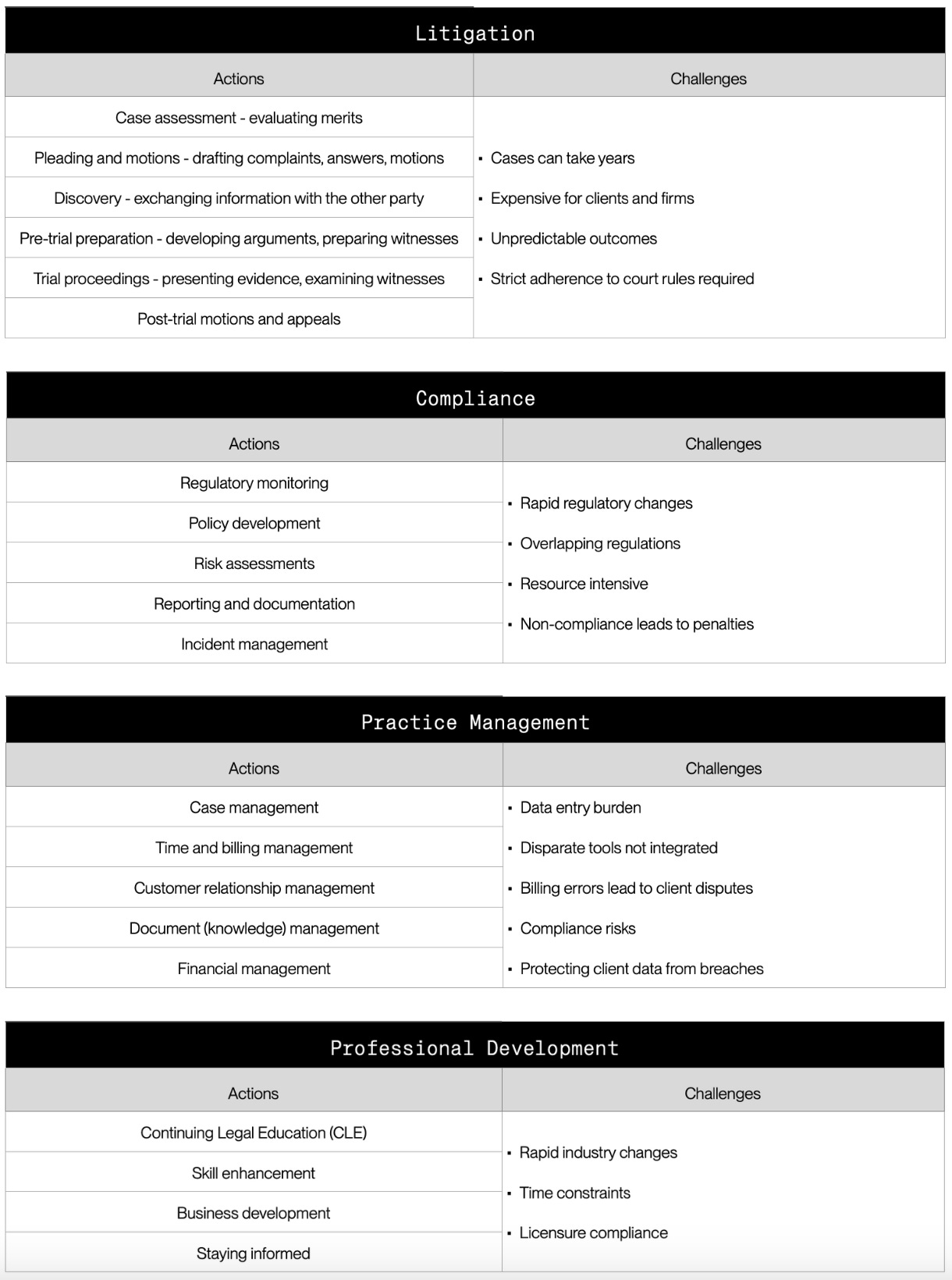
While the demand for legal services continues to grow, so do the complexities and volume of work that legal professionals must manage. AI emerges as a transformative force capable of addressing many of the inefficiencies inherent in traditional legal workflows. These workflows can be broadly categorized into several key stages:
Current Legal Tech Stack
Traditionally, lawyers have relied on integrated solution suites like Microsoft Office for drafting documents, communication and scheduling. The two dominating legal research databases, Westlaw and LexisNexis, are used to access precedents and resources. Case management and billing software, from providers like Clio, MyCase and Rocket Matter, have also been employed to tracking case details and managing invoices. However, the adoption of advanced legal technology remains limited.
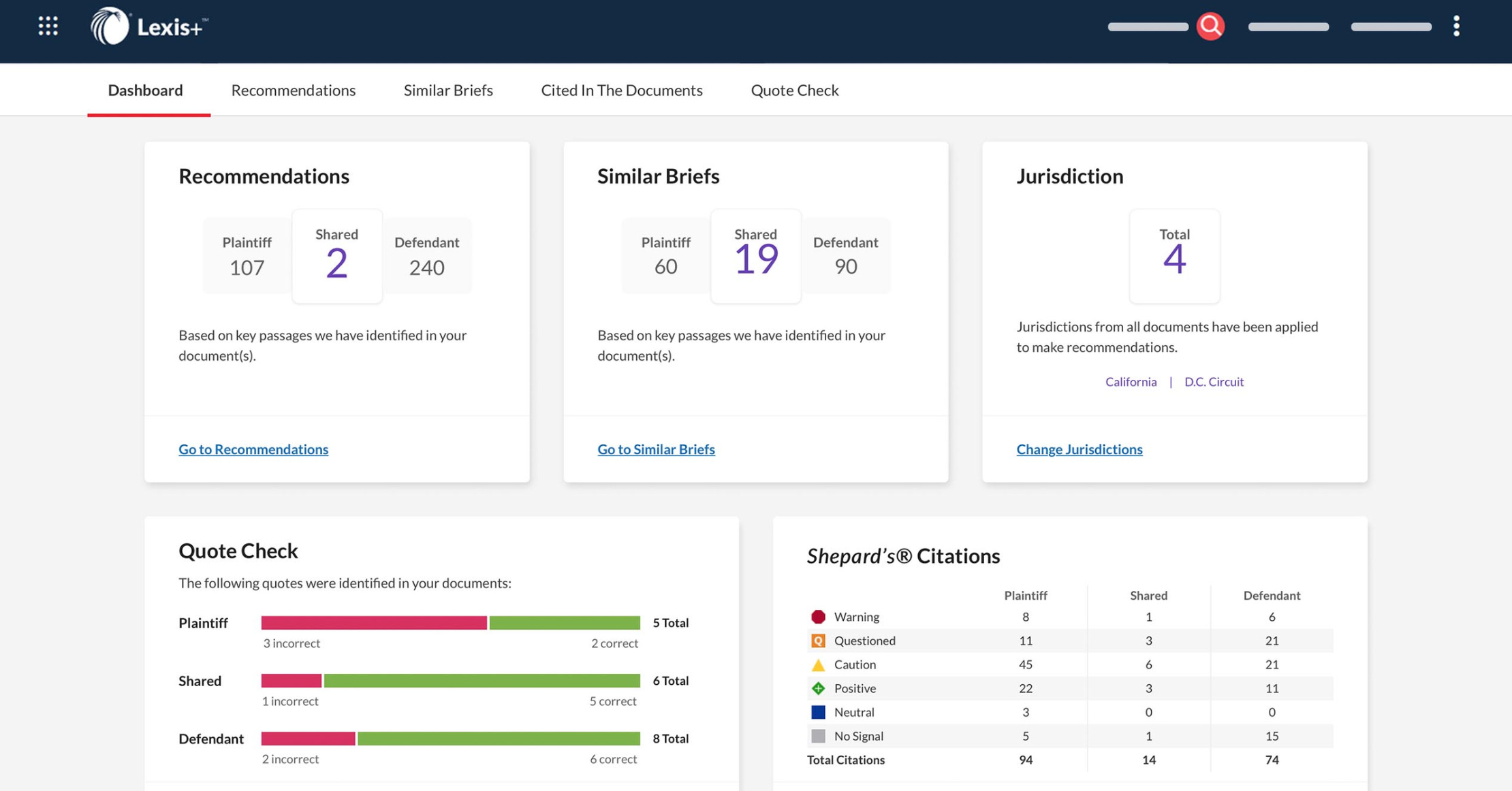
A survey by the American Bar Association (ABA) highlights that many lawyers remain cautious about adopting specialized tools beyond basic applications due to concerns about data security and potential disruptions to established workflows. This hesitation is further compounded by a lack of integration between existing tools, which often requires manual data transfers and undermines efficiency. According to the report, only 53% of law firms currently use case management software, with adoption rates varying based on firm size.
These inefficiencies have significant impacts on productivity, costs, and client satisfaction. According to the Clio Legal Trends Report in 2025, lawyers spend an average of 63% of their workday on non-billable tasks such as administration and operations, leaving only 37% (2.9 hours) for billable work. This drives up operational costs for law firms and legal fees for clients, as prolonged workflows and manual processes increase staff time and resource requirements. Errors also pose substantial risks; for example, a 2018 LawGeex study found that AI achieved 94% accuracy in identifying risks in NDAs, compared to 85% for human lawyers.
Another major challenge lies in the handling of unstructured data in contracts. Legal documents are written in natural language, which is prone to ambiguity and misinterpretation. The lack of standardization and structured formats, such as XML or JSON, limits the ability to automate or analyze contracts efficiently. This inefficiency increases legal expenses for businesses and contributes to disputes that require costly legal intervention.
III. The Technology
Artificial intelligence is reshaping the legal industry, introducing efficiency and innovation into a field traditionally reliant on manual, time-intensive processes. By leveraging AI's ability to process and analyze large volumes of data, lawyers and legal professionals are experiencing a paradigm shift in how they approach high-value tasks like research, contract drafting, compliance monitoring, and litigation strategy.
Law is deeply rooted in precedent, language interpretation, and pattern recognition, making it a natural match for AI. Tasks that were once tedious and repetitive, such as reviewing case law or drafting standard contracts, can now be accelerated and enhanced by machine learning models, freeing up lawyers to focus on complex and creative aspects of their work.
The legal sector's initial adoption of technology centered around automation tools, like e-discovery and ELM software, which helped lawyers sift through massive datasets. Today, the focus has shifted toward intelligence, with AI systems capable of understanding context, predictive analytics and decision-making abilities.

Foundation
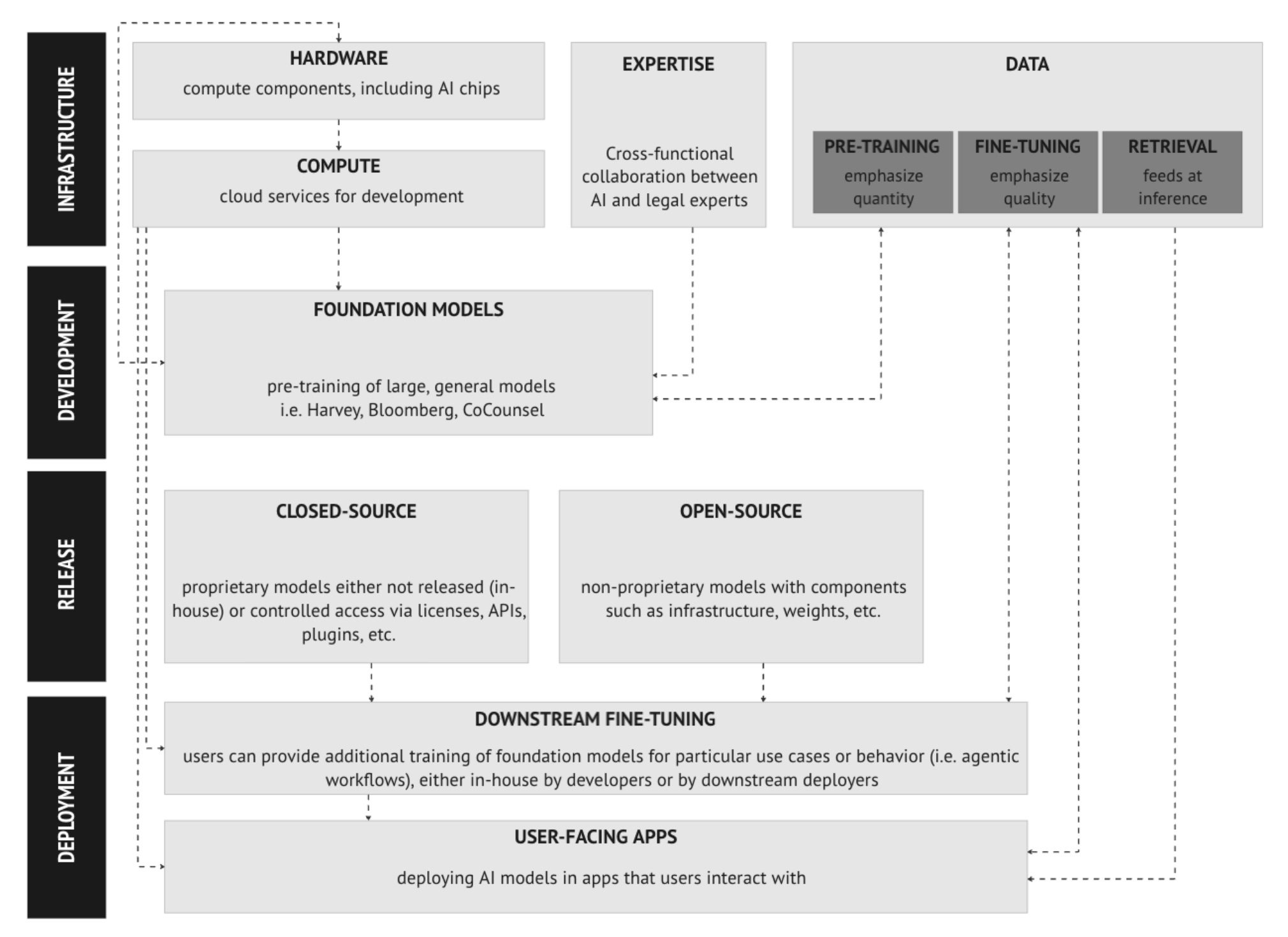
The development and deployment of AI models in the legal industry rely on a robust tech stack that serves as the foundation for innovation. This stack comprises foundation models, compute infrastructure, and specialized data pipelines, which collectively enable legal AI tools to deliver precise and contextually relevant results. For law firms and in-house counsel, the choice of approach depends on their scale, technical capabilities, and specific requirements.
i. Building a Model from Scratch
Involves training an AI model entirely from the ground up, requiring significant investments in data, compute, and expertise.
ii. Building on Open-Source Models
Developers can leverage open-source foundation models (e.g., Llama 2, Gemma 2) and fine-tune them with domain-specific data.
iii. Using Closed-Source Models
Leveraging APIs from providers like OpenAI or Anthropic to access powerful pre-trained models without the need for extensive resources.
iv. Using Existing AI Tools
Law firms and in-house counsel adopt ready-made tools in the application layer, with low barriers to adoption and minimal technical expertise required.
What Makes Sense for Lawyers?
Most law firms are not technology-driven organizations and are unlikely to capture value by developing AI models from scratch or even fine-tuning them. Instead, adopting existing AI tools that are pre-trained or fine-tuned for legal use cases is the most practical approach. These tools can seamlessly integrate into their workflows, allowing firms to focus on business development and legal strategy, rather than technology.
For in-house counsel at large enterprises, the picture is different. These teams may opt for custom fine-tuning of closed-source or open-source models when the company has proprietary data or specialized knowledge that can enhance the AI's performance, as well as when the AI tool can serve multiple departments, not just the legal function.
The Backbone of Legal AI Startups
Pre-trained foundation models form the core of legal AI solutions, supported by cloud computing platforms like AWS, Azure, or Google Cloud for training and deployment. These tools rely on curated legal datasets, including case law, statutes, and corporate policies, combined with cross-functional expertise that blends AI knowledge with deep legal understanding. This ensures tools are both accurate and contextually relevant to the needs of law firms and in-house teams.
Hierarchy of Tools
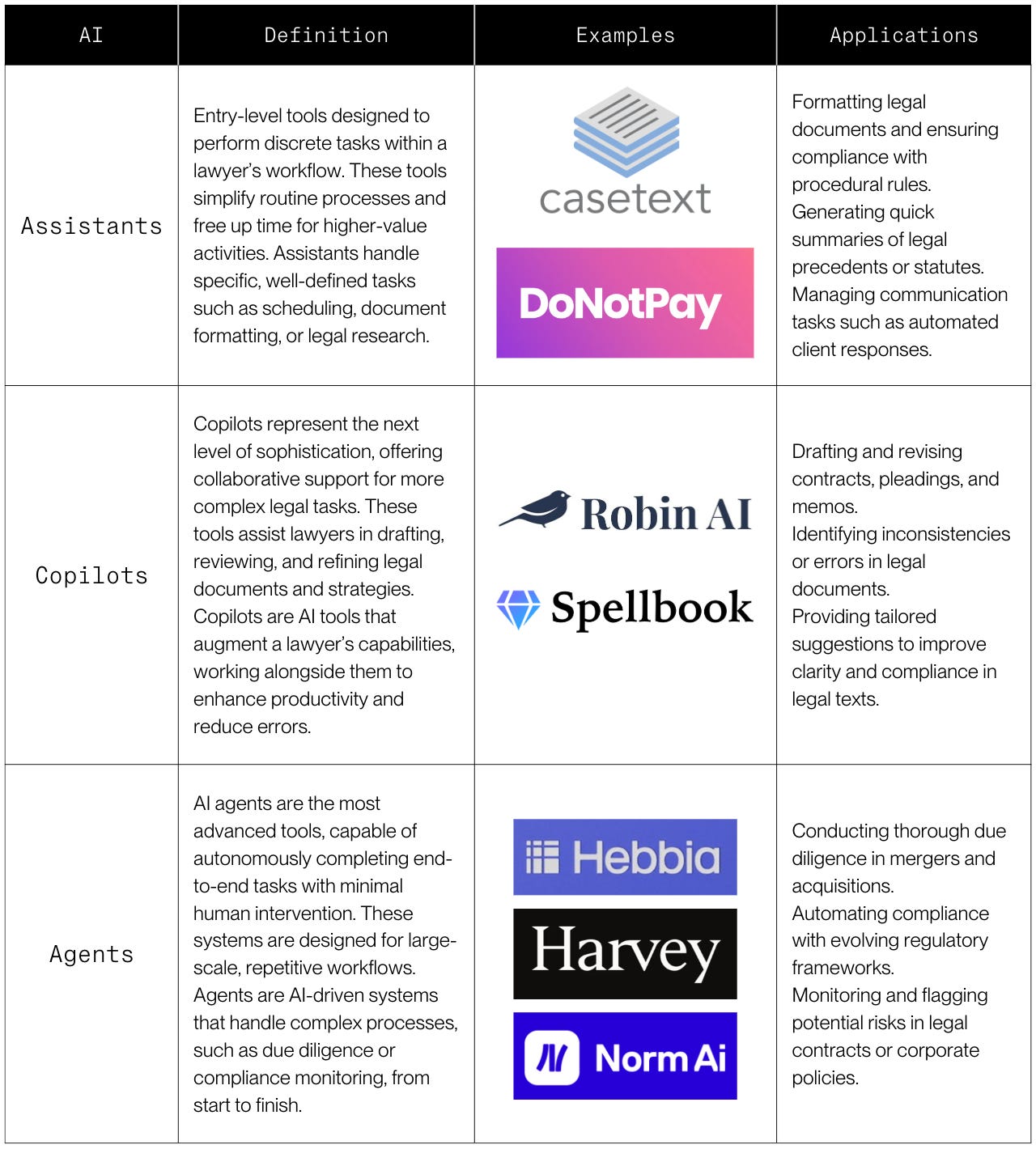
The adoption of GenAI-powered tools by law firms and in-house counsel is influenced by their operating models, internal policies, and specific requirements. Legal AI products can be categorized into three primary levels of complexity: assistants, which focus on discrete tasks; copilots, designed for collaborative and interactive workflows; and agents, advanced systems capable of autonomously executing end-to-end processes.
Opportunities
While current advancements in legal AI are undeniably impressive, significant potential remains untapped. Many experts believe that LLMs are reaching a limit in scaling, and that the next frontier lies in improving reasoning capabilities and enhancing specificity. This creates an opportunity to focus on explainable AI, domain-specific models, and knowledge graphs - each of which can push the boundaries of what legal technology can achieve.
i. Explainable AI
AI systems often operate as “black boxes,” leaving users in the dark about how conclusions or recommendations are reached. This lack of transparency can be a significant barrier to adoption in a field as high-stakes as law. Explainable AI (XAI) addresses this challenge by providing clear explanations for its outputs.
Applications
Litigation Strategy: AI can generate insights and legal strategies with explanations for each recommendation.
Regulatory Compliance: Tools like Norm AI could benefit from enhanced transparency in identifying compliance risks and proposing solutions.
Client Confidence: XAI builds trust by allowing lawyers to validate AI-generated results against known legal standards .
Opportunity
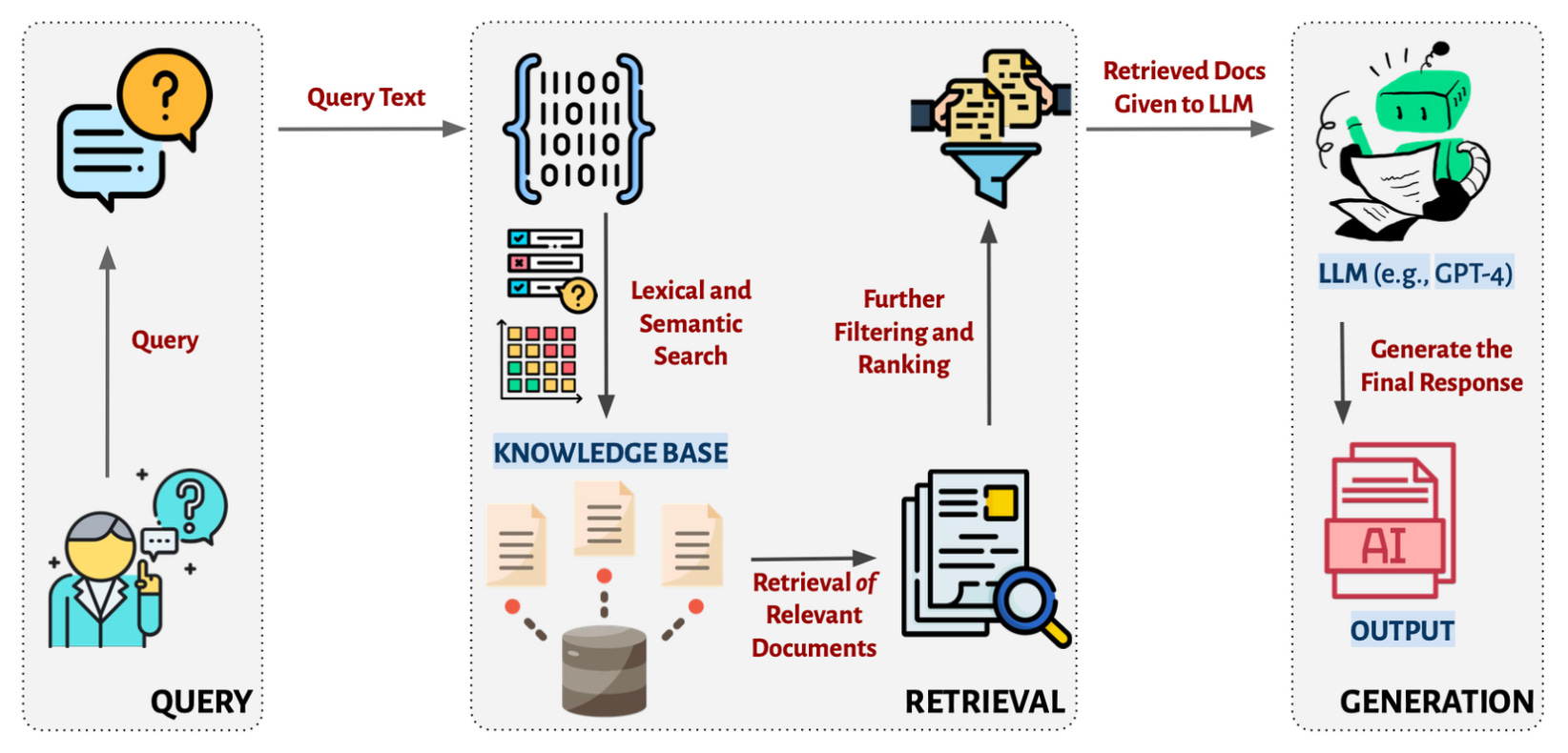
Incorporating transparency mechanisms into RAG workflows to minimize hallucinations while justifying retrieved sources.
ii. Domain-Specific Models
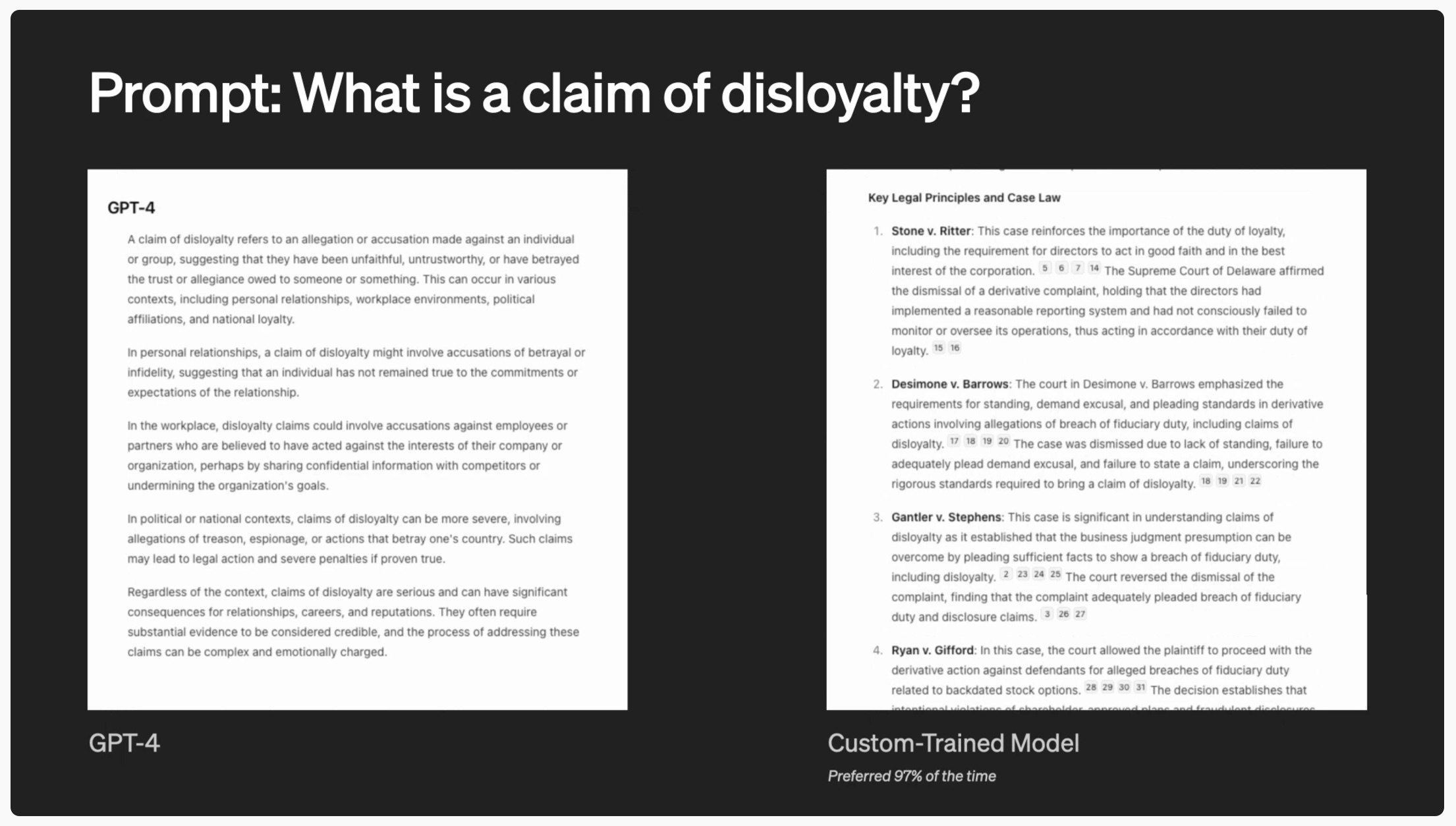
While general-purpose LLMs are versatile, their broad training data often limits their accuracy in highly specialized legal tasks. Domain-specific models are fine-tuned on curated datasets relevant to particular practice areas, offering more precise and contextually relevant insights.
Applications
Custom Workflows: Creating tools tailored for tasks like patent analysis or immigration law documentation.
Enhanced Compliance: Addressing industry-specific regulations (e.g., SEC compliance for financial law or ADA standards for healthcare facilities).
Localized Solutions: Training models for specific jurisdictions or legal traditions, such as common law or civil law systems.
Opportunity
Custom models for areas like family law, real estate law, and tax law can deliver outputs tailored to the unique requirements of those fields.
iii. Knowledge Graphs
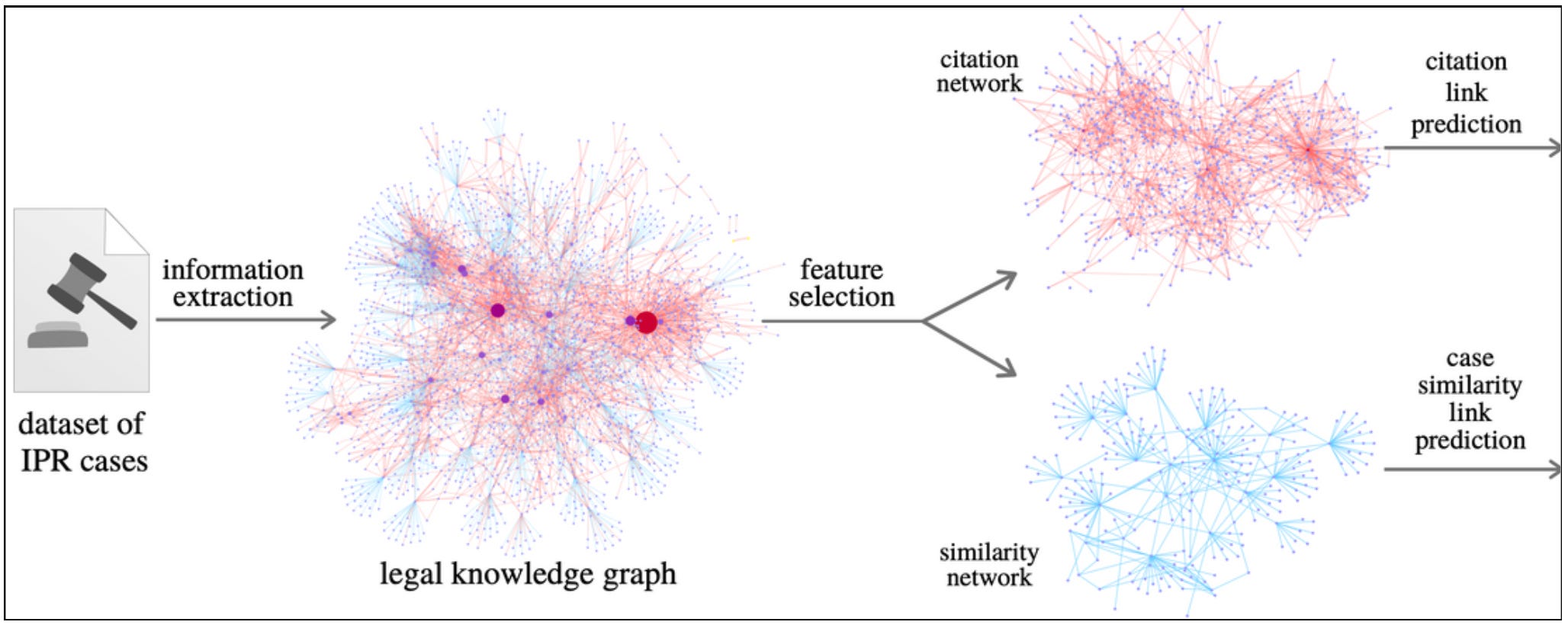
Legal knowledge graphs offer an advanced approach to structuring and utilizing vast repositories of legal information. By representing entities such as court cases, laws, and judicial orders as nodes, and relationships (e.g., citations, legal principles) as edges, knowledge graphs can facilitate sophisticated legal reasoning and document similarity analysis.
Applications
Case Similarity: Tools leveraging graph neural networks (GNNs) can identify similar cases, accelerating legal research and promoting early settlements .
Document Summarization and Retrieval: By infusing knowledge graphs into LLMs, tools can enhance question-answering and summarization tasks .
Predictive Analysis: Predicting outcomes based on historical data and existing relationships in the graph.
Opportunity
Developing robust ontologies for legal documents across jurisdictions.
IV. The Opportunity
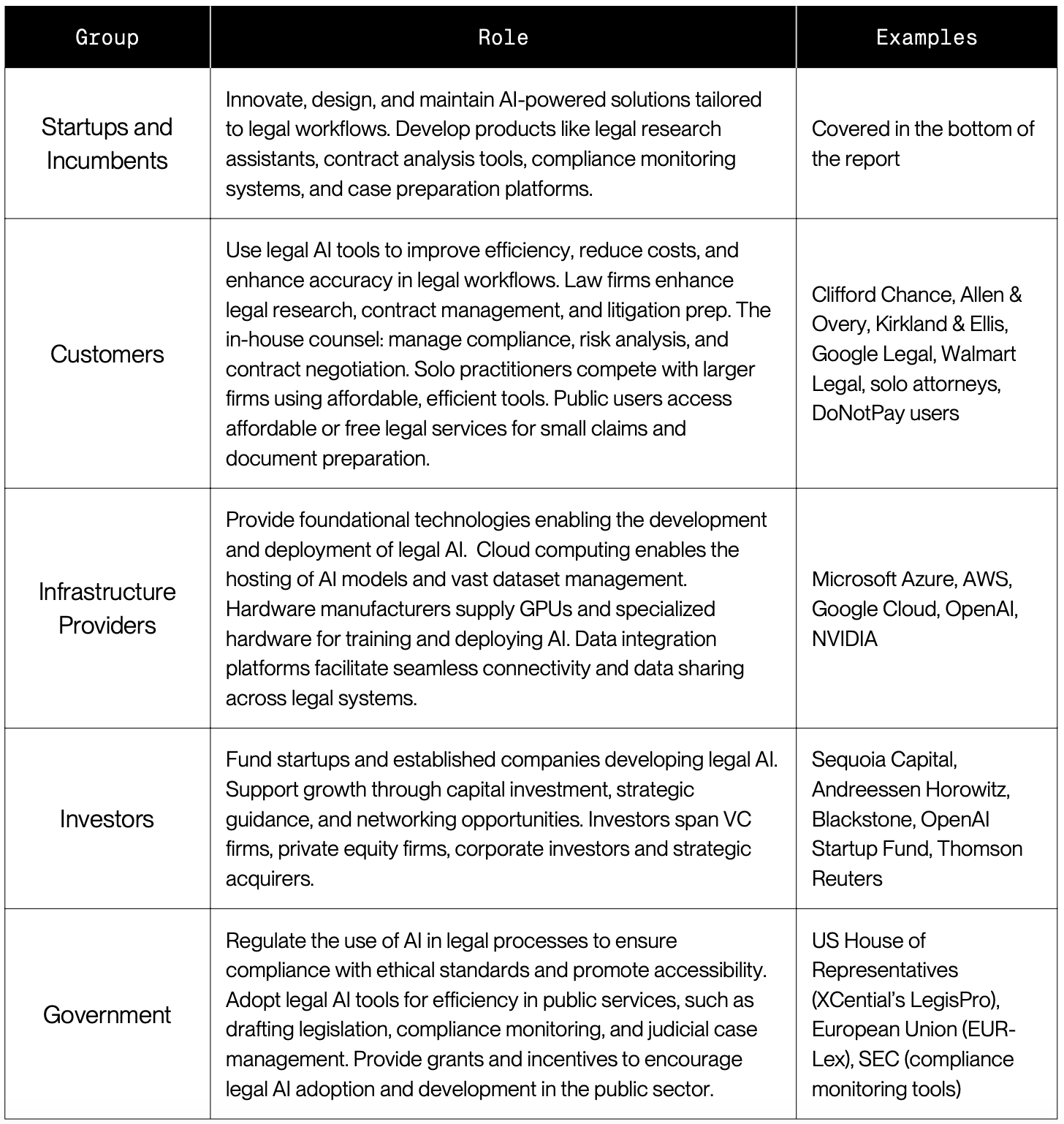
Main Stakeholders in Legal AI
Partnerships
Collaboration is critical for driving adoption and ensuring legal AI solutions meet the practical needs of end-users. Key examples of partnerships in the legal AI ecosystem include:
i. Law firms partnering with startups
↳ PwC partners with Harvey to build domain-specific foundation models
↳ Wilson Sonsini launches AI for document review powered by Dioptra
↳ Fisher & Phillips partners with Hebbia to deploy legal agents
ii. Intra-developer collaborations
↳ Harvey partners with OpenAI to build custom fine-tuned legal models
↳ Robin AI builds on top of Anthropic’s Claude 3 on Amazon Bedrock
↳ Casetext’s CoCounsel is powered by OpenAI’s GPT-4, the first AI to pass the bar
iii. Strategic M&A
↳ Thomson Reuters acquires Casetext for $650 million
↳ Workday acquires Evisort for an undisclosed amount
↳ Docusign acquires Lexion AI for $165 million to enhance its IAM platform
Pricing and Demand Drivers
Legal AI tools drive adoption by addressing critical challenges faced by legal professionals. They significantly reduce non-billable working hours by automating tasks like research, compliance checks, and document review, allowing lawyers to focus on higher-value activities. Cost savings are another key factor, as firms can handle more work with fewer resources. These tools also simplify complexity management, ensuring compliance with increasingly intricate regulations and cross-border legal issues. Lastly, adopting AI helps firms stay competitive, as keeping up with peers who leverage advanced technology becomes essential in a rapidly evolving legal landscape.
Representative Pricing
Harvey: $1,200 per seat/year (100-seat minimum), targeting larger law firms.
Hebbia: $15,000 per license/year for advanced use cases like M&A due diligence.
Lexis+ AI: $323–$1,083/month, tiered plans for research and compliance.
Robin AI: Freemium to $100/month for Pro, with enterprise-level options available.
Genie AI: £250–£8,500/year, accessible for both small firms and enterprises.
Labor Market
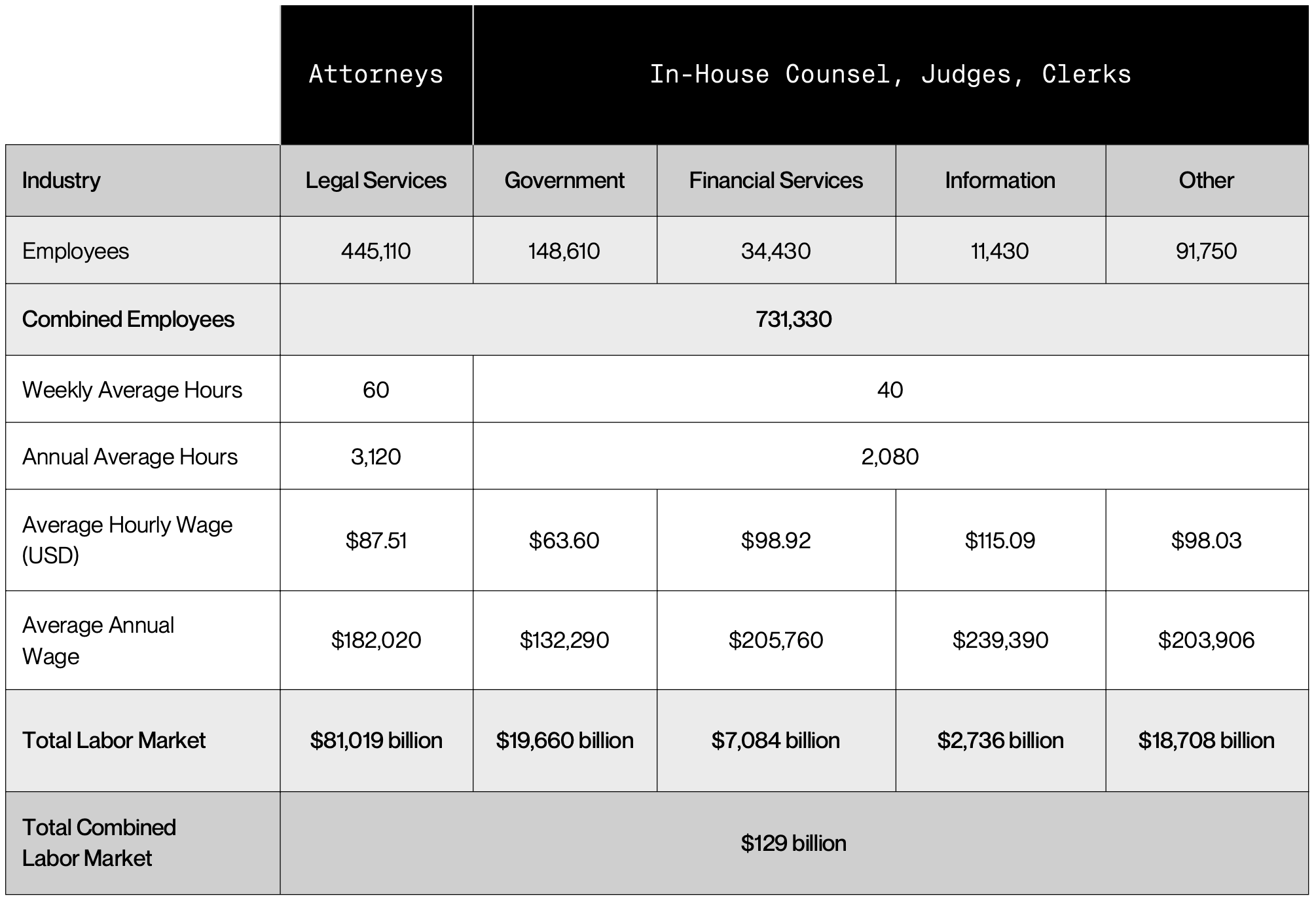
While legal AI tools are unlikely to replace professionals in law firms, they aim to significantly reduce non-billable hours and free up time for high-value legal tasks - thus increasing the amount of billable hours a law firm can monetize and augmenting the workforce. As it comes to in-house teams and governmental workers, we believe that as more SMEs and enterprises adopt AI solutions, there will be less demand to retain staff in these positions, and complex legal work will be delegated to law firms.
Using data from the Bureau of Labor Statistics (BLS) and industry-specific insights, we identify the combined labor market of legal professionals - spanning private law firms, in-house legal teams and the government as the total addressable market.
Modeling Assumptions
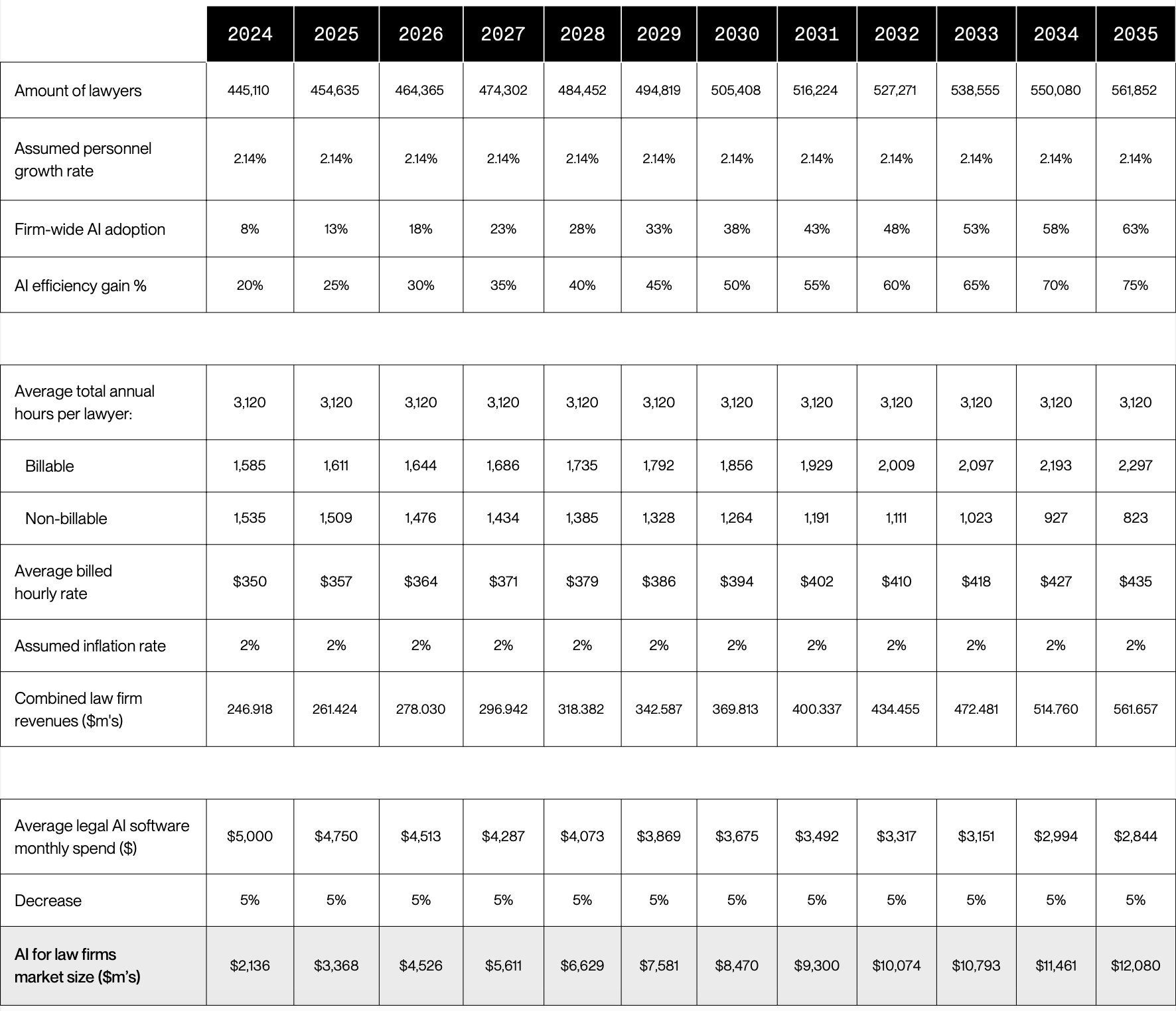
To estimate the market size, we developed two distinct models: one for law firms and another for in-house legal teams and the government. Law firms focus on increasing billable hours by minimizing the time spent on non-billable tasks like research and document review.
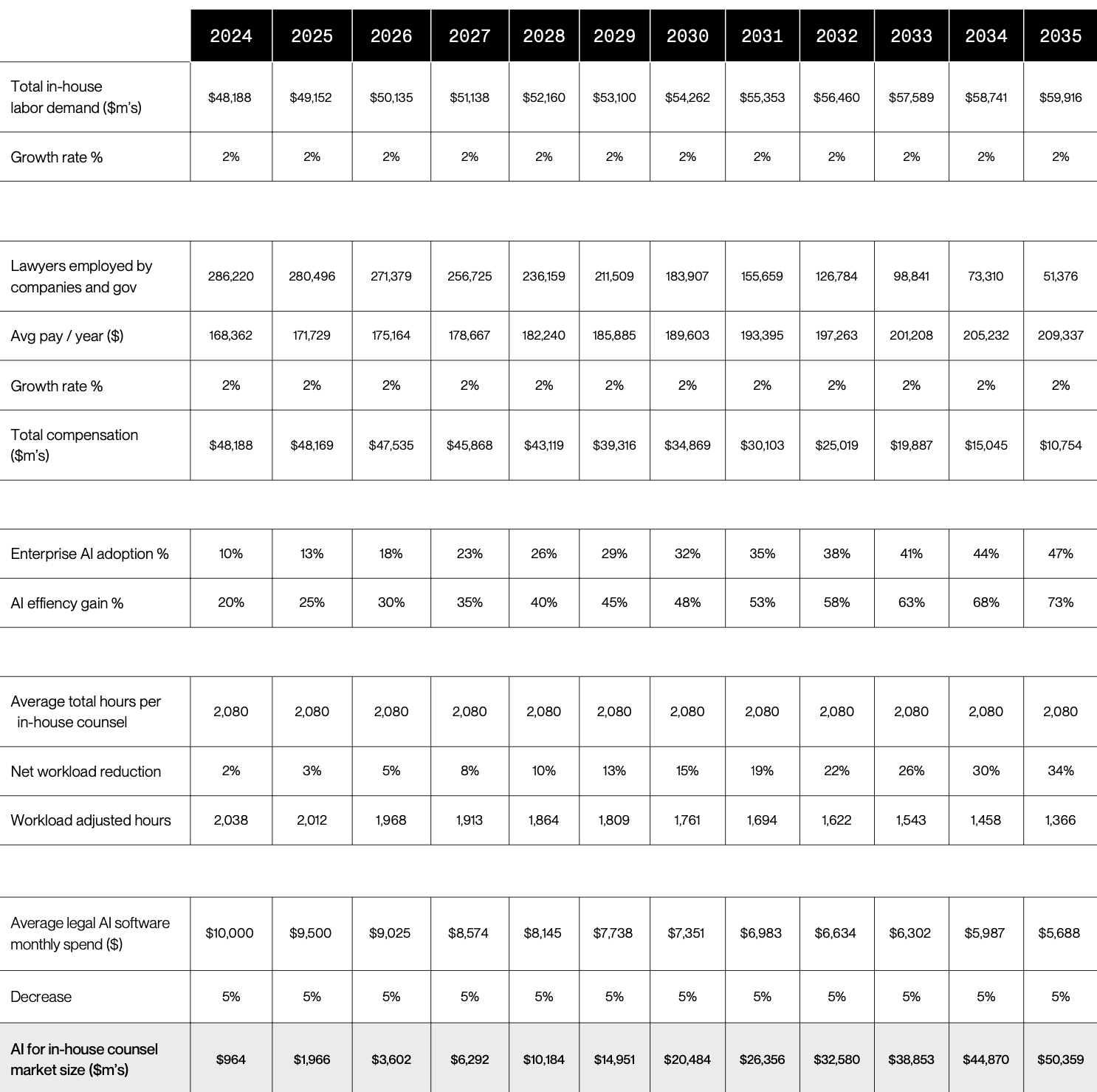
In contrast, in-house legal teams are retained by businesses, who aim to reduce legal costs by improving internal efficiency.
Law Firms
AI Adoption Rates: Starting at 8% firm-wide adoption in 2024, increasing at an
s-curve as AI tools become more integrated into legal workflows.AI Efficiency Gains: Initial efficiency gain is set at 20%, increasing at an s-curve, reflecting the improvement in AI capabilities.
Work Hours Distribution: Lawyers work an average of 3,200 hours per year, split evenly between billable (50%) and non-billable (50%) hours.
Impact on Billable Hours: AI adoption converts non-billable hours into billable ones, directly increasing revenue potential for firms.
Growth in Workforce: The number of lawyers in law firms grows by 2% annually, reflecting steady demand for legal services and the industry ’s ability to generate more work.
Subscription Costs: The average AI subscription bundle for law firms is assumed to be $5,000 per month per seat and will reduce on an annual rate, as solutions become democratized.
In-House Counsel
AI Adoption Rates: Adoption starts at 10% in 2024, increasing at an s-curve as businesses increasingly turn to AI for compliance, contract management, and regulatory tasks.
AI Efficiency Gains: Initial efficiency gain is set at 15%, with an s-curve increase as AI solutions improve.
Workload Reduction: AI adoption reduces the total hours required for legal tasks, allowing teams to maintain the same workload with fewer professionals.
Demand Growth: Total demand for in-house legal work grows at 2% annually, reflecting overall economic expansion and increasing regulatory complexity.
Market Size Basis: The market size is calculated based on total legal demand in hours, adjusted for efficiency gains and changes in workforce size.
Subscription Costs: The average AI subscription stack for legal departments in enterprises is assumed to be $10,000 per month per seat and will reduce at an annual rate.
Autopilot Law Firm AI Market Forecast: 2025 - 2035
Autopilot In-House AI Market Forecast: 2025 - 2035
As Legal AI solutions become increasingly sophisticated and accessible, we expect them to transform the legal industry. This adoption mirrors historical patterns seen in other industries, where technological advancements have driven efficiency and cost reductions at scale. The legal sector, with its high labor costs and complex workflows, is particularly well-positioned to benefit from this trend as AI solutions free up professionals to focus on higher-value tasks.
Market Size Projection
Based on our projections, the Legal AI market is expected to grow from an estimated $5.3 billion in 2025 to approximately $62.4 billion by 2035, representing a compound annual growth rate (CAGR) of 28%. This growth will be fueled by widespread adoption among law firms and in-house legal teams seeking to enhance efficiency, reduce costs, and improve decision-making capabilities. As AI capabilities improve and trust in these tools increases, Legal AI will become an integral part of the industry’s future, driving significant economic value.
V. The Innovators
As artificial intelligence continues to revolutionize industries, the legal profession is undergoing a transformative shift. A new generation of innovative companies is at the forefront of this change, leveraging cutting-edge AI, machine learning, and legal expertise to solve some of the field’s most complex challenges - from reducing non-billable hours to improving access to justice and simplifying compliance with intricate regulations.
This report spotlights the Top 10 companies driving the Legal AI revolution. These pioneers are not only pushing the boundaries of what AI can achieve in the legal space but are also reshaping the way law firms, in-house counsel, and solo practitioners operate. Each company brings a distinct vision and solution to the table, collectively advancing the efficiency, accuracy, and accessibility of legal services in an increasingly complex world.
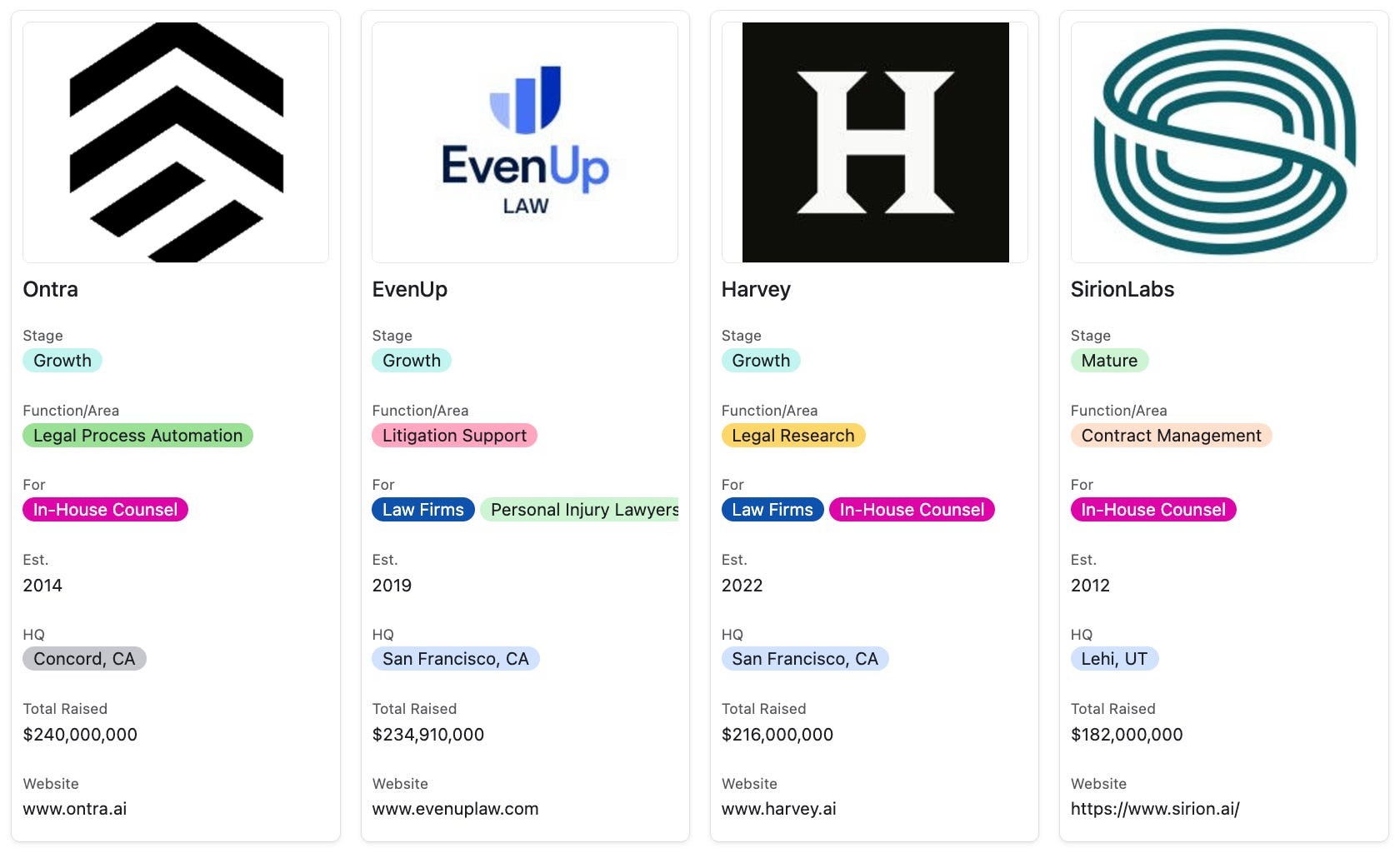
To view the full company list in gallery or spreadsheet format, access the following Airtable file →
Harvey AI
OpenAI-backed custom legal models
HQ: 🇺🇸 San Francisco, CA
Founded: 2020
Website: harvey.ai
Headcount: 155
Total Raised: $216,000,000
Harvey streamlines legal workflows with its AI-driven tools: Assistant for reviewing and drafting contracts, Vault for secure document storage and analysis, Research for up-to-date legal insights, and Workflow for tasks like redlining and translation. A standout innovation is Harvey’s custom-trained case law model, built through a combination of pre- and post-training on US case law, retrieval-augmented generation, and hybrid search. This approach enables the AI to perform legal research akin to a junior associate, synthesizing complex queries into precise, actionable results. In 2023, Harvey partnered with OpenAI and PwC to redefine legal workflows through AI.
Leadership: Winston Weinberg - CEO and Co-Founder
Gabriel Pereyra - President and Co-Founder
Andy Ozment - Security Advisor
Clark Smith - Security Advisor
Eisar Lipkovitz - Security Advisor
Partners and Customers: Allen & Overy, Macfarlanes, KKR, Bridgewater, Bayer, PwC
Select Investors: OpenAI, GV, Sequoia, Elad Gil, Kleiner Perkins, SV Angel
Hebbia
The AI platform for knowledge work
HQ: 🇺🇸 New York, NY
Founded: 2020
Website: hebbia.ai
Headcount: 97
Total Raised: $158,100,000
Hebbia revolutionizes legal workflows with its enterprise-grade search tool, Matrix, designed for tackling complex, multi-step queries. Released in 2024, Matrix enables professionals to analyze vast amounts of unstructured and structured documents, such as PDFs, emails, and spreadsheets, by extracting answers to detailed, user-specified questions. Tailored initially for private equity diligence, Hebbia has expanded its focus to the legal industry, targeting inefficiencies like document review and contract analysis. By providing search results in a tabular format, Matrix streamlines due diligence and research, helping legal teams manage complex queries and gain a strategic advantage in negotiations.
Leadership: George Sivulka Ph.D - CEO and Co-Founder
Raymond Verbeke - Strategy
Alex Immerman - Board Member
Michelangelo Volpi - Partner, Index Ventures
Partners and Customers: Fenwick, Fisher Phillips, Gunderson Dettmer, OHA
Select Investors: a16z, GV, Index Ventures, Peter Thiel, Eric Schmidt
Casetext
The Legal AI OG
HQ: 🇺🇸 San Francisco, CA
Founded: 2013
Website: casetext.com
Headcount: 104
Total Raised: $67,980,000
Casetext, acquired by Thomson Reuters in 2023 for $650 million, is a legal AI pioneer transforming how attorneys work. Its flagship product, CoCounsel, leverages OpenAI’s GPT-4 to assist with document review, legal research, deposition preparation, and contract analysis, providing seamless, AI-driven workflows for over 10,000 law firms and corporate legal departments. Initially founded as a legal text-sharing platform in 2013, Casetext pivoted to AI and ML becoming a leader in generative AI for legal teams. The acquisition aligns with Thomson Reuters’ $100 million annual AI investment strategy, embedding advanced AI capabilities across its legal, tax, and accounting product verticals.
Leadership: Jacob Heller JD - CEO and Co-Founder
Laura Safdie - COO and Co-Founder
Pablo Arredondo JD - CIO and Co-Founder
Partners and Customers: Sheppard Mulin, O'Melveny & Myers, Fisher Phillips
Select Investors: Thomson Reuters, YC, WEF, Union Square Ventures
NormAI
AI agents for regulatory compliance
HQ: 🇺🇸 New York, NY
Founded: 2022
Website: norm.ai
Headcount: 27
Total Raised: $38,390,000
Norm AI addresses the complexity of modern compliance by transforming dense regulations into actionable AI agents. Its Regulatory AI platform breaks down massive legal texts, such as 1,000-page federal codes, into manageable units for analysis, enabling large language models to assess compliance efficiently. Founded by John Nay, a pioneer in legal AI education, Norm AI is tailored for compliance officers in heavily regulated industries, particularly financial services. By automating repetitive compliance tasks and validating results through a human-overseen decision tree, Norm AI not only reduces costs but also embeds societal values into AI systems.
Leadership: John Nay Ph.D - CEO and Founder
Patrick Vergara JD - COO
Paul Healy JD - Legal Engineer
Sri Viswanath - Angel
Partners and Customers: Fortune 100 (undisclosed)
Select Investors: BCV, Blackstone, Citi Ventures, Coatue Management
Bloomberg Law
The only legal model trained from scratch
HQ: 🇺🇸 Arlington, VA
Founded: 1929
Website: bloomberglaw.com
Headcount: 1,837
Total Raised: N/A
As an affiliate of Bloomberg LP, the Bloomberg Law platform benefits from access to hundreds of AI researchers, enabling continuous innovation in the legal domain. Bloomberg Law harnesses advanced AI to streamline legal research, enhance content discoverability, and provide actionable insights across its vast repository of legal data. With access to over 200 million dockets, 15 million court opinions, 5 million codified statutes and regulations, and 75 million EDGAR filings, Bloomberg Law utilizes machine learning and LLMs to transform this wealth of information into practical tools for legal professionals, through its Extraction, Search and Summarizations product offerings.
Leadership: Josh Eastright - CEO
Mike McCarty - CFO
Bobby Puglia - CMO
Partners and Customers: AmLaw 100 (undisclosed)
Select Investors: Bloomberg LP
Robin AI
Secure Legal AI for private markets
HQ: 🇬🇧 London, UK
Founded: 2018
Website: robin.ai
Headcount: 178
Total Raised: $70,880,000
Robin AI, in partnership with Anthropic, leverages advanced generative AI to streamline contract management and legal workflows. Its tools include Robin AI Review for accelerating contract review and minimizing redlines, Robin AI Query for instant clause and obligation searches, and Robin AI Reports for generating multi-contract reports at scale, with a particular focus on M&A due diligence. Supported by its Robin AI Services team, the company combines cutting-edge AI capabilities with human expertise to deliver precise and scalable solutions for legal teams and in-house counsel. Looking ahead, Robin AI is exploring the integration of AI agents to execute chained, formulaic tasks seamlessly, aligning AI with existing legal workflows, rather than requiring teams to adapt to the technology.
Leadership: Richard Robinson - CEO and Co-Founder
James Clough - CTO and Co-Founder
Scott Casey - CFO
Ming You See - Board, Temasek
Partners and Customers: UCIM, Convex Insurance, Investindustrial, Blue Earth
Select Investors: Temasek Holdings, SoftBank, Paypal, University of Cambridge
DocuSign
The e-signature OG evangelizing 'IAM'
HQ: 🇺🇸 San Francisco, CA
Founded: 2003
Website: docusign.com
Headcount: 6,840
Total Raised: $1,023,000,000
DocuSign, trusted by over 1 billion users and 1.5 million businesses worldwide, is revolutionizing the way agreements are managed with its Intelligent Agreement Management (IAM) platform. Building on its legacy as the pioneer of e-signatures, DocuSign is creating a new software category that transforms static, unstructured agreement data into actionable insights. IAM enhances every stage of the agreement lifecycle, from faster contract creation and smarter negotiations to proactive risk management. By leveraging AI, DocuSign simplifies complex agreements, highlights key terms, and accelerates review cycles, enabling organizations to boost productivity and make informed decisions quickly. Tailored IAA applications, including solutions for sales and customer experience teams, ensure that businesses of all sizes can maximize the value of their agreements.
Leadership: Allan Thygesen - CEO
Blake Grayson - CFO
Anwar Akram - COO
Sagnik Nandy Ph.D - CTO
Dmitri Krakovsky - CPO
Enrique Salem - Board, Bain Capital Ventures
Partners and Customers: United, PwC, JPMorgan, Cisco, JBS USA, Hershey
Select Investors: Vanguard, BlackRock, T Rowe, State Street, RenTech
EvenUp
Bringing intelligence to injury lawsuits
HQ: 🇺🇸 San Francisco, CA
Founded: 2019
Website: evenuplaw.com
Headcount: 384
Total Raised: $234,910,000
EvenUp leverages AI to streamline the creation of demand packages for personal injury law firms, addressing a traditionally labor-intensive process. By reviewing medical records, bills, and incident reports, EvenUp’s platform automates the extraction of critical information, significantly reducing the time and errors associated with manual preparation. Its proprietary database of over 250,000 public verdicts and private settlements informs precise case valuations, while LLMs craft compelling case narratives for demand letters. EvenUp equips attorneys with high-quality, data-driven demand packages, enabling faster settlements and fairer outcomes for clients. Trusted by over 1,000 law firms to handle over 1,000 demands and MedChrons weekly, resulting in attorneys claiming more than $1.5 billion in damages for their plaintiffs.
Leadership: Rami Karabibar - CEO and Co-Founder
Raymond Mieszaniec - COO and Co-Founder
Saam Mashhad - CPO and Co-Founder
Kacper Kula - Co-Founder
Sameer Dholakia - Partner, Bessemer
Partners and Customers: McCready Law, Anthem, Smith Law Center
Select Investors: BCV, Bessemer, Lightspeed, Clio, Gokul Rajaram, Scott Belsky
VI. Scenarios
Scenario I: REIT Acquisition
Your law firm has been retained by a New York-based Real Estate Investment Trust (REIT) to manage the acquisition of a portfolio of senior care homes in Florida. The REIT aims to negotiate a lower purchase price by uncovering risks related to commercial leases, regulatory compliance, and operational inefficiencies. The transaction involves reviewing 100+ commercial leases, financial disclosures, employee contracts, and healthcare compliance records under a tight deadline.

i. Document Centralization
Objective: Securely store and organize all transaction-related documents for analysis.
Leverage Harvey, integrated with OneDrive via Microsoft Azure, to automatically upload, organize, and tag all relevant documents (e.g., leases, contracts, and compliance reports).
Use OneDrive’s tagging feature to categorize files by type, date, and facility for easier navigation and collaboration.
ii. Commercial Lease Review
Objective: Identify risks and opportunities in the 100+ leases tied to the senior care homes.
Deploy Hebbia to extract critical clauses (e.g., rent escalation, termination rights, and maintenance obligations); flag high-risk leases containing restrictive terms or clauses that could reduce the portfolio’s valuation.
Generate a tabular report comparing lease terms across the portfolio, making it easy to identify discrepancies or unfavorable trends.
Summarize findings in Harvey for inclusion in the valuation report.
iii. Regulatory Compliance Review
Objective: Ensure compliance with healthcare and employment regulations.
Use Norm AI to verify adherence to the Americans with Disabilities Act (ADA) and Florida healthcare standards. Flag facilities with potential accessibility violations or incomplete compliance documentation.
iv. Financial Due Diligence
Objective: Validate disclosures and identify underperforming assets or hidden liabilities.
Use Hebbia’s advanced analysis capabilities to summarize cash flow statements and balance sheets across facilities, and redline discrepancies between reported financials and operational data.
Highlight facilities with inflated occupancy rates, unreported liabilities, or unsustainable operating costs.
v. Employee Contract Analysis
Objective: Review employee contracts to uncover labor risks and obligations.
Use Hebbia to extract key terms from employment agreements, such as non-compete clauses, severance obligations, and unionization risks.
Tag contracts with potential liabilities, such as those with unusually high severance payouts.
vi. Negotiation Strategy Development
Objective: Equip the REIT with a data-driven strategy to justify a reduced purchase price.
Use Harvey to draft and redline the purchase agreement, incorporating findings from Hebbia and Norm AI.
Generate a summary highlighting the most critical risks and their potential financial impact.
Prepare counter-arguments and alternative deal terms based on identified risks.
Scenario II: Supply Agreement
As in-house counsel for a leading supermarket chain, you are negotiating a 5-year, $50M supply agreement with a new vendor for sustainable grocery bags. The agreement requires strict adherence to environmental compliance regulations and includes provisions for intellectual property ownership of co-developed sustainable packaging technologies. Your primary goals are to ensure regulatory compliance, secure favorable contract terms, and mitigate risks related to performance and IP disputes.

i. Document Centralization
Objective: Organize all negotiation-related documents for efficient collaboration.
Use Clio to set up a centralized case file for the supply agreement. Store all drafts, communications, and supporting documents in Clio’s cloud-based system.
Tag documents by category (e.g., compliance requirements, IP clauses) and associate tasks and deadlines for easy tracking.
ii. Environmental Compliance Review
Objective: Ensure the agreement complies with environmental laws and sustainability goals.
Use Norm AI to analyze the vendor’s proposed terms for compliance with the Clean Air Act and state-level sustainability mandates. Flag clauses that are non-compliant or lack specificity, such as vague commitments to carbon reduction.
Summarize compliance findings in Clio to share with sustainability and procurement teams.
iii. Drafting and Negotiating IP Clauses
Objective: Protect your company’s ownership of co-developed intellectual property.
Use Norm AI to review the vendor’s IP ownership proposals, identifying any terms that could dilute your company’s rights.
Draft alternative IP clauses directly in Clio, ensuring that co-developed technologies remain exclusive to your company. Collaborate with stakeholders via Clio’s task management feature for input on preferred IP terms.
iv. Streamlining Contract Review and Approval
Objective: Efficiently review, revise, and approve the agreement.
Use DocuSign to generate a summary of the agreement for non-legal stakeholders, highlighting key terms and risks.
Automate workflows for review and approval, ensuring input from all required departments (e.g., procurement, legal, and sustainability). Track changes and comments in real time during negotiations with the vendor.
v. Managing Risk and Reporting to Stakeholders
Objective: Communicate key risks and opportunities to internal teams for informed decision-making.
Use Clio to create a dashboard summarizing environmental compliance risks flagged by Norm AI, IP ownership concerns and suggested revisions, and vendor performance obligations with fallback clauses.
Generate reports from Clio to share with procurement and operations teams.
vi. Finalizing and Executing the Agreement
Objective: Secure signatures and finalize the agreement while ensuring all terms meet company standards.
Use DocuSign to manage the e-signature process, ensuring quick and secure approvals from all parties.
Store the executed agreement in Clio’s document management system for future reference and audits.
Scenario III: Food Poisoning Lawsuit
Your law firm represents a group of plaintiffs who suffered severe food poisoning after eating at a national fast-food chain. The case involves gathering medical evidence, proving negligence in food safety practices, and negotiating a settlement or preparing for litigation. The goal is to efficiently manage the case, compile a compelling demand package, and secure a favorable outcome for the plaintiffs.

i. Case Intake and Organization
Objective: Collect and organize all case details for efficient management and collaboration.
Use Filevine to centralize client intake forms, witness statements, and supporting documents, such as medical records and receipts. Assign tasks and deadlines to team members, ensuring all necessary follow-ups are completed on time.
Set up a timeline to track key events, such as the meal date, symptom onset, and treatment progression.
ii. Medical Chronology and Evidence Compilation
Objective: Build a clear medical history to establish causation and quantify damages.
Leverage EvenUp to extract critical details from medical records, summarizing treatments, diagnoses, and incurred costs. Compile a medical chronology linking the food poisoning incident to documented symptoms and medical interventions. Flag any missing documents or gaps in the medical timeline for further follow-up.
iii. Legal Research and Precedent Analysis
Objective: Strengthen the case by identifying relevant legal precedents and comparable cases.
Use CoCounsel to conduct legal research on food safety negligence cases and identify applicable precedents. Find case law supporting the plaintiffs’ claims, including prior judgments and settlements involving similar incidents.
Incorporate findings into the demand package and negotiation strategy to bolster the case.
iv. Demand Package Preparation
Objective: Create a persuasive demand package that outlines the plaintiffs’ claims and seeks appropriate compensation.
Use EvenUp to draft a demand letter summarizing the incident, detailing damages, and proposing a settlement amount based on precedent data. Include supporting documentation, such as medical records, receipts, and expert testimony, to substantiate the claims.
Reference historical settlements from similar cases to justify the requested amount.
v. Negotiation Preparation
Objective: Equip the legal team with data-driven insights to secure a favorable settlement.
Use EvenUp to analyze historical settlement data to assess potential outcomes and strengthen negotiation strategies. Prepare talking points and counterarguments tailored to adjuster behavior and the strengths of the case.
Use Filevine to organize negotiation documents and track updates to settlement discussions.
vi. Settlement and Resolution
Objective: Finalize the agreement or prepare for litigation if settlement efforts fail.
Use Filevine to track settlement offers, manage client approvals, and maintain transparent communication with plaintiffs. Archive settlement agreements and supporting documents for future reference or audits.
Prepare for trial by leveraging CoCounsel for drafting motions and refining arguments with relevant case law.
We expect legal AI adoption to grow as technology advances and costs decrease. These tools are already reducing time spent on routine tasks like document review and legal research, enabling firms and in-house teams to allocate resources more effectively. As efficiency gains compound, legal AI solutions will become integral to standard legal workflows, driving measurable improvements in productivity and cost management across the industry.